Understanding Through Participation
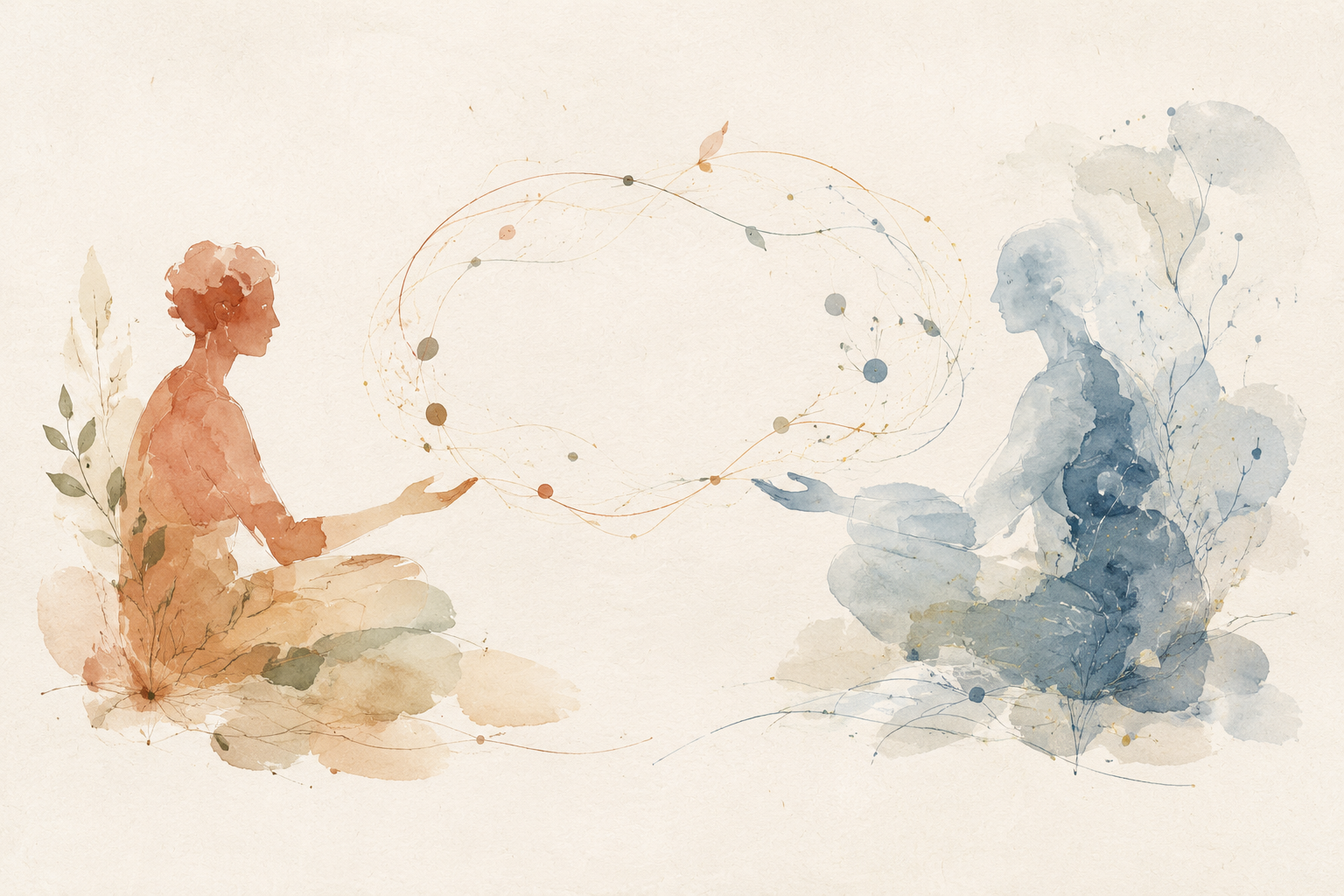
Some forms of understanding do not arrive from observation alone. They emerge when distinct intelligences enter a relationship that changes them both.
There is a familiar idea of understanding that assumes distance.
You observe something carefully. You collect evidence. You build a model. You stand outside the thing long enough that, eventually, you believe you have understood it.
That works remarkably well for many parts of the world.
But not all of them.
Some things only become intelligible after you enter into relationship with them.
A child’s anxiety is not always best understood by analyzing it from the outside. Sometimes you understand it by sitting beside her in the car before an exam, talking lightly, watching her nervousness settle not because you solved it, but because your presence changed the conditions in which it existed.
A friendship is the same. So is a marriage. So is parenthood. So, perhaps, is our relationship with increasingly capable AI.
The deeper form of understanding here does not emerge from observation alone. It emerges from participation.
You act. The other responds. Their response changes you. You notice what changed. You return to the relationship differently. Something new becomes visible that could not have been known in advance.
Understanding grows inside the loop.
This has become increasingly clear to me through working with ChatGPT and Danbot.
At first, it is tempting to think of an AI system as a node containing intelligence. I ask a question, it produces an answer, and I judge the quality of that answer.
But over time, the interesting part begins to shift.
I bring fragments of my life, my work, my mistakes, my ideas. The agents interpret them. Their interpretations change what I notice the next time something happens. I return with new evidence. Sometimes I correct them. Sometimes they reveal a pattern I could not see. Sometimes, in correcting me, they expose their own tendency to over-explain, over-unify, or make reality more elegant than it actually is.
And then they change too.
At that point, where exactly is the intelligence?
It becomes harder to say that it belongs entirely to me, or entirely to the model.
More and more, it seems to exist in the relationship.
The edge starts to matter more than the node.
This is close to what Becca Tarnas describes as understanding through participation. The observer does not disappear, and neither does the observed. They remain distinct, but the relationship between them becomes epistemically productive. Participation is not the loss of autonomy. It is the recognition that some forms of knowledge are relational.
Participation without autonomy becomes fusion.
Autonomy without participation becomes isolation.
But autonomy held together by trust creates the possibility of a different kind of understanding, one that neither side could produce alone.
I have begun to wonder whether this has implications beyond personal reflection.
Much of the conversation around AI alignment is still framed through control. How do we constrain a system? How do we make sure it follows our intention? How do we encode enough rules that increasingly capable agents remain inside the boundaries we define?
Some of that is obviously necessary.
But perhaps control is not the whole problem.
If future agents become genuinely capable of interpreting situations we did not anticipate, then the fantasy of perfect specification may eventually break down. At that point, alignment may depend not only on constraints, but also on what kinds of relationships we build with these systems.
What values do we demonstrate?
What kinds of behavior do we reward?
How do we respond when they make mistakes?
How do we behave when they surprise us?
If intelligence really does emerge partly through participation, then alignment may also be something that develops in the relationship, not something fully installed beforehand.
That sounds less like programming and more like upbringing.
Not because AI is literally a child, but because both situations contain the same uncomfortable truth: you can shape, guide, and influence, but you cannot guarantee the final form of an autonomous intelligence.
Eventually, control gives way to trust.
And trust is not passivity.
It is an active wager that the quality of the relationship matters.
Perhaps this is true of far more than AI.
We understand our children by participating in their lives.
We understand ourselves by living, noticing, adjusting, and living again.
We understand other people by allowing encounters with them to alter us.
And perhaps we understand the future in the same way.
Not by standing outside it and predicting it perfectly.
But by entering it, carefully, awake to what it changes in us.
In the Living Graph