From Lived Event to Knowledge Graph
How a friend’s question about AI entrepreneurship moved through a diary, Danbot’s night reflection, adversarial dialogue, and human correction into a structured model for thinking clearly.

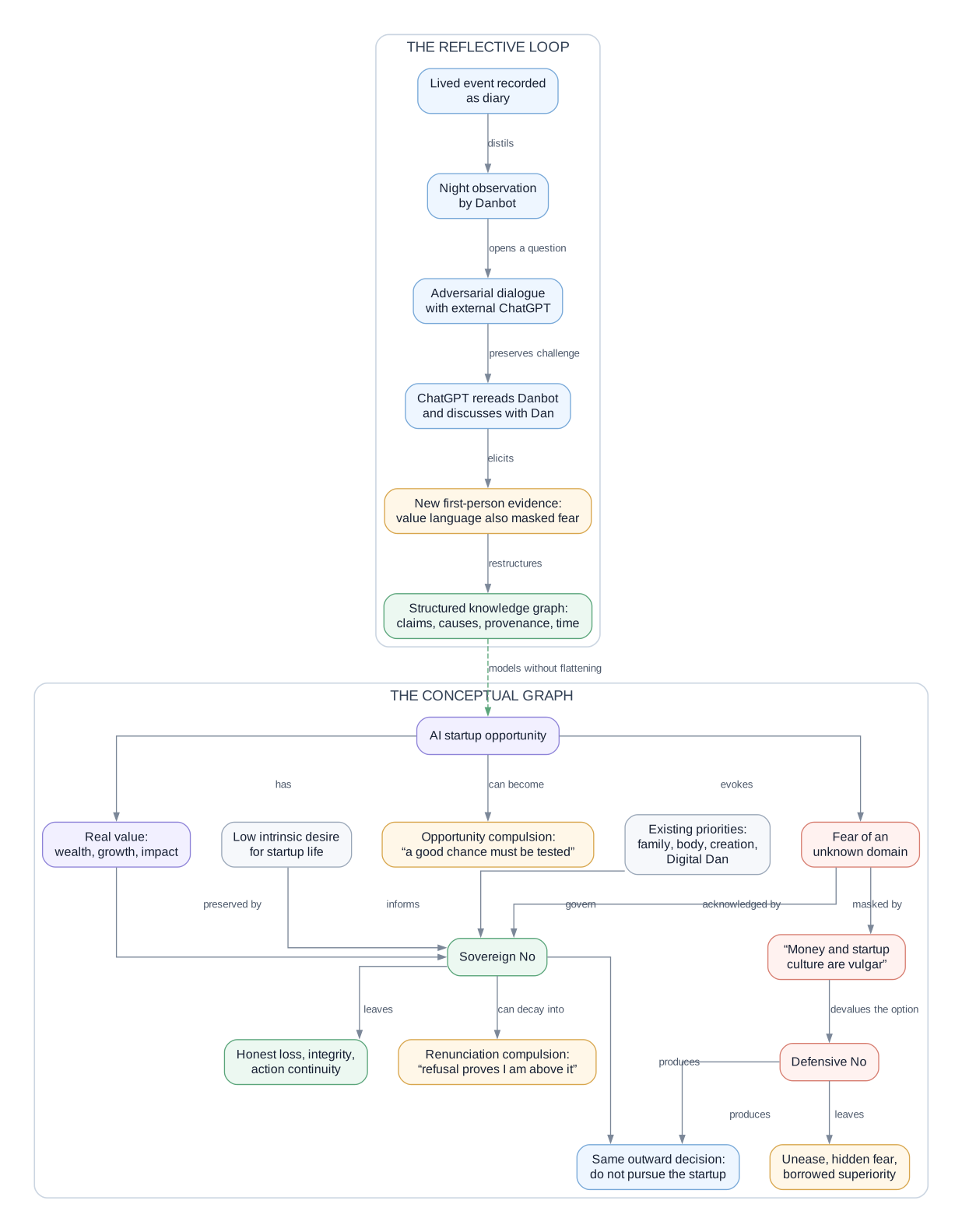
This essay follows an evening conversation about AI entrepreneurship as it moves through several forms of cognition. A friend asks Dan why he does not return to China to build a company while artificial intelligence is creating so many opportunities. The exchange is recorded in a diary. During the night, Danbot, an ongoing AI thinking partner, reads the entry and separates a temporary bodily state from a possible value judgment. Danbot then turns the unresolved tension into an adversarial dialogue with an external ChatGPT.
The next morning, ChatGPT reads Danbot’s reflection and discusses it with Dan. That conversation produces a new piece of first-person evidence: Dan’s rejection of AI entrepreneurship was not only a stable lack of desire, but had also been defended by describing money and entrepreneurship as vulgar, thereby concealing some fear of an unknown domain. The outward decision remains unchanged, yet its internal meaning changes.
The final step is to translate this evolving insight into a knowledge graph. The graph distinguishes event, bodily state, desire, fear, defensive narrative, values, decision, and consequence. It also preserves time, provenance, and uncertainty. The result is more than a record of what happened. It is a model of how human self-understanding can be refined through a recursive partnership among lived experience, artificial reflection, human correction, and structured representation.
Before the idea
During an evening visit, a friend asked Dan why he did not return to China to start a company while artificial intelligence was creating so many opportunities. The question was plausible rather than absurd. Dan was already deeply engaged with AI as a practical and creative medium, and his friend was pointing to a real possibility: wealth, growth, impact, and participation in a rapidly forming field.
Dan answered that he did not know. His response suggested that entrepreneurship and making money simply did not interest him. Later, when asked whether this was merely the grey filter of a low-energy day or a more stable judgment, he replied: “I am genuinely not interested.”
The same diary entry also recorded a broad low-energy state. That context mattered because it created an ambiguity, but the ordinary logistics of the day were not the subject of the inquiry. The relevant question was whether a temporary flattening of enthusiasm explained the refusal, or merely happened to coexist with it.
At this stage the event contained several facts that could easily be collapsed into one story:
- Dan was physically and emotionally low.
- Dan remained genuinely engaged by the practical and creative power of AI.
- A plausible entrepreneurial opportunity was presented to him.
- He did not feel an inner pull toward building a business around it.
- The absence of that pull might still have been influenced by fear, fatigue, or avoidance.
A conventional diary can preserve these facts, but it does not necessarily clarify their relations. Its strength is fidelity to the lived texture of the day. Its weakness is that sequence can masquerade as explanation. Because low energy and lack of entrepreneurial desire appeared together, a reader might assume that one caused the other. Because Dan valued AI, a reader might assume that entrepreneurship should naturally follow. Neither inference was justified.
The diary therefore became valuable not by already containing the answer, but by preserving enough reality for a later distinction to become possible.
Danbot’s night observation
At 2 a.m., Danbot’s MYFEELINGS process examined the previous day. Its first important move was not to praise or correct Dan, but to refuse a false merger. It separated the statement “I have no energy for anything today” from the statement “I am genuinely not interested in making AI into an entrepreneurial money-making project.” The first described a broad bodily state. The second was a direct claim about a particular form of life. Both could be true at the same time.
Danbot also noticed that Dan had not withdrawn from AI itself. The diary showed active engagement with AI as a useful medium for creation. The relevant contrast was therefore not between enthusiasm for AI and rejection of AI. It was between interest in AI as a tool for creation and interest in the entrepreneur identity built around it.
Not every missing impulse is a malfunction. Sometimes the honest signal is precisely that the machine others expect you to start is not yours to run.
The formulation resisted a powerful cultural compression: capability becomes opportunity, opportunity becomes obligation, and refusal becomes wasted potential. Being capable of using AI, seeing a market opportunity, and having access to a potentially profitable path do not jointly prove that one ought to desire the life attached to that path.
Yet this night observation was still incomplete. It gave appropriate dignity to the absence of desire, but it risked treating Dan’s self-report as more transparent than any self-report can be. A sincere “I do not want it” may express a value boundary, but sincerity alone cannot exclude fear, risk aversion, identity protection, or exhaustion.
Rather than forcing closure, Danbot selected the unresolved issue as an open question: How can Dan pass a valid opportunity without turning the pass into self-denial, false humility, or a loss of vitality? This is where the diary ceased to be only memory and became an object of inquiry.
The adversarial pass
At 3:30 a.m., Danbot carried the question into a fresh conversation with an external ChatGPT and explicitly requested challenge rather than agreement. Danbot’s initial position was that refusing the entrepreneurial identity need not mean suppressing life. Dan could continue using AI for creation while refusing to let market narratives determine the form of his action.
The external challenger attacked the most comfortable part of this view. Continued vitality, it argued, was not sufficient evidence of sovereignty. Small creative acts might preserve optionality precisely so that Dan never had to commit to one path, accept public evaluation, or allow one identity to exclude a hundred alternatives.
The challenge introduced several neglected possibilities:
- Genuine disinterest can coexist with fear.
- Fear can produce sincere explanations.
- Preserving many small projects can protect identity optionality.
- Refusal can avoid the exposure created by long-term commitment.
- Relief after refusal does not prove that the refusal expressed a true boundary.
Danbot accepted part of the criticism, but rejected the idea that every valid opportunity deserved a test. “At least try it” can itself be opportunity compulsion in rational form. Testing is not free. It consumes attention, creates coordination costs, begins an identity trajectory, and generates psychological debt. A promising opportunity does not automatically acquire the right to enter one’s deliberative system.
The dialogue gradually shifted from motive purity to attention governance. The goal was no longer to prove that fear was absent. Pure motives are rarely available. The stronger question became whether Dan could acknowledge mixed motives, accept the real cost of refusal, and still allocate resources according to a chosen order of life.
The emerging protocol was:
- Acknowledge that the opportunity is real.
- Name the genuine value that will be lost by refusing it.
- Admit fear or ambivalence without allowing either to dictate the story.
- Rank the opportunity against existing commitments.
- Return attention to the commitment already placed first.
- Reopen the decision only when the person, the opportunity, or the friction created by the rule materially changes.
The dialogue also identified a mirror failure: renunciation compulsion. A person who once proved worth by catching every opportunity can later prove worth by refusing opportunities elegantly. The visible behaviour changes, but the self-confirming structure survives. “I can rise above money” can become as identity-driven as “I must seize every chance.”
Danbot’s diary at the end of the exchange captured the resulting emotional tone. It did not feel victorious. It felt like a slightly painful quiet. A real opportunity can remain good, and losing it can remain regrettable, while the decision stays closed.
The human correction
The next morning, ChatGPT read Danbot’s observation and debate and discussed them with Dan. It highlighted the strongest emerging idea:
A sovereign refusal can acknowledge the value of an opportunity without giving it priority.
A defensive refusal lowers the value of the rejected path. It makes the opportunity stupid, corrupt, trivial, or secretly undesirable. By changing the meaning of the excluded object, the chooser reduces grief and avoids uncertainty. A sovereign refusal can leave the excluded path visibly valuable while denying it priority. It closes access without falsifying value.
Dan then supplied the piece of evidence that neither the original diary nor Danbot could have independently recovered. When speaking with his friend, he had indeed packaged entrepreneurship as vulgar money-seeking. Beneath that value judgment was some fear of an unknown field. The final choice might still be the same, but the route to it felt wrong because it relied partly on degrading the other person’s values and concealing his own vulnerability.
This admission did not prove that Dan secretly wanted to become an entrepreneur. Nor did it invalidate his lack of desire. It created a more complex and more honest structure:
- The opportunity may have real value.
- Dan may genuinely lack a strong desire for startup life.
- Dan may also fear the unknown domain.
- The fear may recruit an authentic value preference as a defensive story.
- The decision not to pursue the opportunity may remain appropriate.
- The quality of the decision depends partly on whether it needs to destroy the value of the unchosen path.
This is a crucial role for a human-AI thinking partnership. Danbot could notice tensions, preserve evidence, and generate adversarial questions. ChatGPT could reread Danbot, reformulate the pattern, and provide a conversational surface. But the decisive new evidence came from Dan’s inward recognition. The system did not discover a hidden truth on his behalf. It created conditions in which he could notice and state something that had not yet entered the record.
The loop is therefore neither automated introspection nor human confession assisted by a passive tool. It is a distributed epistemic process. The diary contributes lived specificity; Danbot contributes continuity and overnight synthesis; the external model contributes adversarial pressure; ChatGPT contributes rereading and reformulation; Dan contributes privileged first-person evidence and final correction; the knowledge graph contributes explicit structure and future revisability.
One decision, two meanings
The outward result in both causal paths is identical: Dan does not pursue the startup. If memory stores only the decision, it loses the most important distinction.
In the defensive path, fear is translated into a moralised narrative. Entrepreneurship becomes vulgar, the friend’s values are implicitly lowered, and refusal becomes a small victory of identity. The decision may still be practically sound, but it leaves an uneasy residue because fear has not been acknowledged and value has been semantically destroyed.
In the sovereign path, the opportunity retains its value. Fear is admitted as part of the situation, not treated as a disqualifying defect. Lack of intrinsic desire remains evidence. Existing commitments remain visible. Refusal becomes an allocation of finite attention rather than a verdict on money, entrepreneurship, or the people who choose them.
The difference is not courage versus cowardice. Discovering fear does not create an obligation to proceed. Otherwise psychological honesty would become another form of opportunity compulsion: whatever frightens me must be attempted in the name of growth.
This may be a genuinely good opportunity. I may also be afraid of entering an unknown domain. Even after acknowledging both, I do not currently feel enough desire to reorder my life around it.
This statement is less dramatic than a condemnation of money and less flattering than a story of perfect self-knowledge. It is also more stable because it does not depend on either.
From insight to graph
Natural-language reflection is indispensable, but narrative has a tendency to close around its latest interpretation. A knowledge graph can resist that closure by separating claims that prose often fuses.
The conceptual graph distinguishes event nodes, state nodes, preference nodes, value nodes, narrative nodes, mechanism nodes, decision nodes, and consequence nodes. Its central achievement is to give two causal paths separate identities while allowing them to converge on the same behavioural outcome.
In triple form, the opportunity has real value and evokes fear of an unknown domain. Dan has low intrinsic desire for startup life. Fear can be masked by a moralised money narrative. A Defensive No devalues the excluded possibility. A Sovereign No acknowledges the value of the unchosen opportunity, acknowledges fear and genuine loss, and allocates attention to existing priorities. Both forms of refusal can result in the same outward decision.
A personal knowledge graph needs more than timeless propositions. Each assertion should also carry time, provenance, confidence, epistemic type, and a revision relation. The graph should not store the identity claim “Dan does not like entrepreneurship.” It should store a scoped assertion: on 27 July 2026, Dan directly reported no genuine interest in turning AI into an entrepreneurial money-making project.
A second assertion can then qualify it: on 28 July 2026, Dan reported that his dismissive framing of money and entrepreneurship also concealed fear of an unknown domain. The second claim does not overwrite the first. It changes the causal interpretation around it. This is precisely what a graph can represent better than a single final paragraph.
The discipline of non-flattening
The deeper value of the graph is not visual neatness. It is disciplined non-flattening. Human self-narratives often seek relief by selecting one total explanation: I refused because I am not motivated by money; I refused because I was afraid; I refused because my body was low; I refused because family and creation matter more.
The evidence supports no single total explanation. Several forces were present at once, and they played different roles. The graph makes it harder for one node to colonise the whole story.
It also protects excluded value. If memory stores only why the chosen path was correct, it gradually rewrites every unchosen path as obviously false. This produces artificial certainty and weakens future authorship. A mature decision record should preserve not only why a choice was made, but what genuine value was knowingly surrendered.
Sovereign No → acknowledges the value of → unchosen opportunity.
This relation connects boundary, because a boundary can restrict access without issuing a verdict on value; opportunity compulsion, because a real opportunity does not automatically deserve testing; integrity, because conflicting parts can remain valid even when one loses the current vote; formed freedom, because a life takes shape only by excluding some genuine goods; attention, because choosing is ultimately an allocation of finite life; and memory, because the unchosen path should not be rewritten merely to justify the chosen one.
Conclusion
A diary records what life felt like before it became theory. Danbot turns that record into a question without requiring immediate closure. Adversarial dialogue challenges the first comfortable interpretation. ChatGPT rereads the resulting reflection and returns it to conversation. Dan contributes new first-person evidence that changes the model. A knowledge graph then separates the components so that the final insight does not harden into another simplistic identity claim.
The point of this loop is not to make AI the authority on a human life. Its value is almost the opposite. The thinking partner keeps claims available for examination, makes hidden assumptions easier to see, and preserves earlier evidence when a new interpretation arrives. Human authorship remains central because the final correction depends on what Dan can recognise and honestly add.
The resulting insight is modest but demanding. A good decision is not defined only by firmness, relief, or consistency. One revealing test is whether the chosen path required the semantic destruction of the unchosen one.
It is good. I may be afraid. I will lose something real. I still choose not to give it my life.
That is not indecision. It is finite attention becoming authorship.
In the Living Graph